
If you’re surprised that The Social Reckoning is in theaters this weekend because you haven’t heard much about it, you’re not alone.
After all, its predecessor, The Social Network, wasn’t just a hit; it was a cultural event — a three-time Oscar winner, endlessly quotable, and, in my opinion, not just the best movie of 2010 but the best movie of the 2010s. It actually made Facebook’s origin story fascinating and cool, even though we all knew what the site had become in the years since.
The follow-up has the same screenwriter, Aaron Sorkin. And Jeremy Strong (Succession) takes over for Jesse Eisenberg as Mark Zuckerberg. Suffice it to say, my hopes were high.
Well, it turns out there’s a good reason Sony has kept quiet about this one.
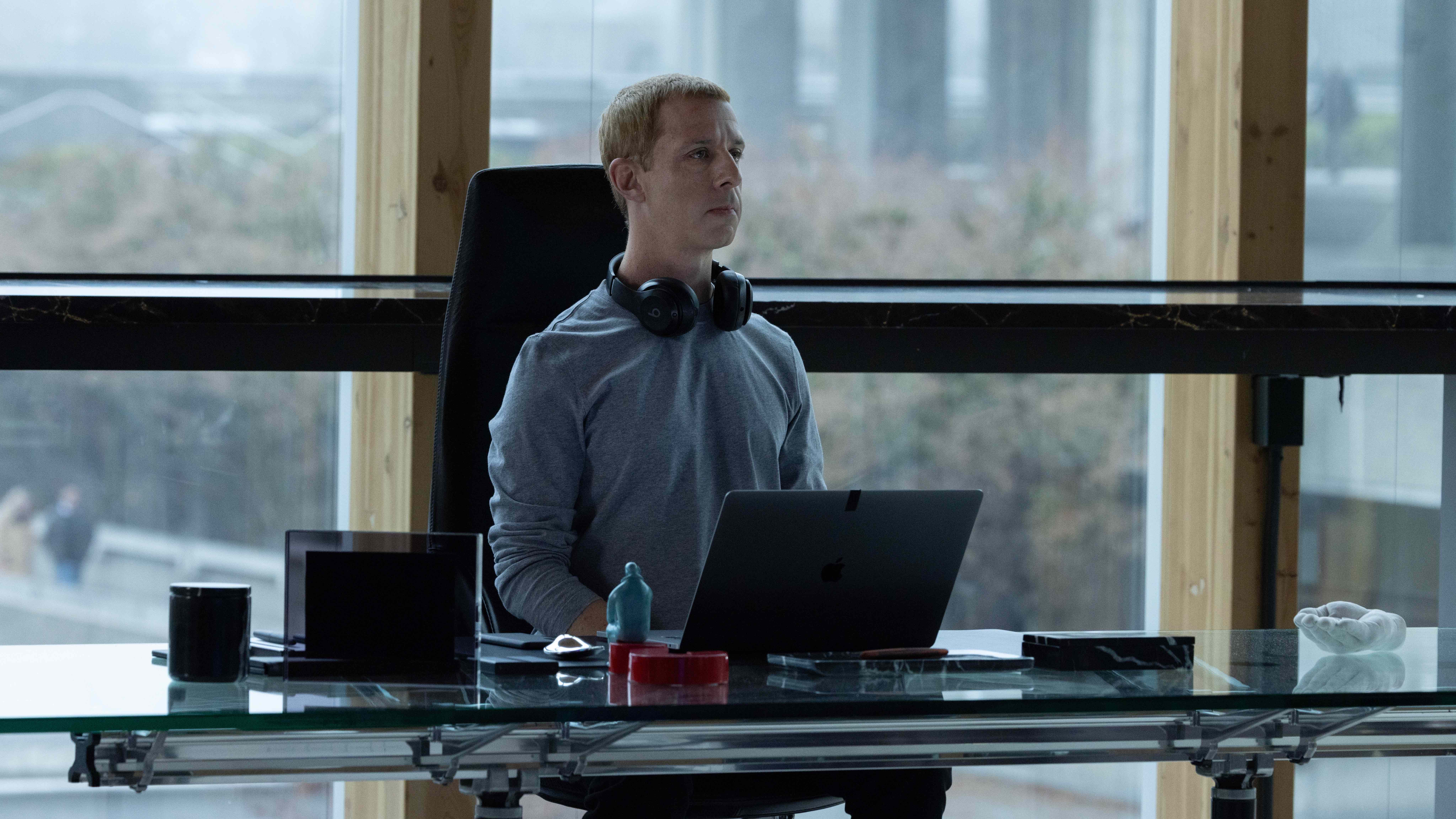
The Social Reckoning is a largely one-dimensional indictment of Facebook and Zuckerberg that essentially argues the company is responsible for just about everything wrong with society, while Zuckerberg doesn’t particularly care, as long as the money keeps rolling in. Zuck as a character has come a long way from the hoodie-wearing college dropout he was in The Social Network. Strong plays him with impressive, reptilian intensity, as a man who has evolved from awkward Harvard coder into a billionaire so insulated from normal human behavior that he might as well live on Mars.
Good as Strong is, though, this version of Zuck couldn’t — and shouldn’t, and thankfully, doesn’t — carry the movie. Instead, the main character this time out is Wall Street Journal reporter Jeffrey Horwitz (Jeremy Allen White, Deliver Me from Nowhere), a fish-out-of-water more comfortable covering Washington politics than Silicon Valley technology, who is investigating Facebook with the help of whistleblower Frances Haugen (Mikey Madison, Oscar winner for Anora).
Haugen initially insists she loves her job and isn’t interested in helping Horwitz bring down her employer. But she has a change of heart, which leads to Horwitz writing the 17-part “Facebook Files,” which was published shortly after January 6, 2021 — a timing coincidence the movie practically puts under a neon sign.
The movie wants to be an urgent, All the President’s Men–style journalism thriller for the social media age. And there’s plenty here to make you think twice about using Facebook. Learning about its “Meaningful Social Interactions” initiative, for example, is enough to make you wonder whether your news feed is actually feeding you anything meaningful at all.
But whereas The Social Network used Facebook to explore ambition, friendship, betrayal, and the intoxicating dangers of power, The Social Reckoning uses Facebook to explain why Facebook is bad.
That’s not an entirely incorrect argument. The film makes a strong case that Facebook’s engagement-obsessed algorithms help amplify anger, misinformation, and division. It just doesn’t make for as compelling a movie.
It doesn’t help that the movie often feels like Sorkin doing an impression of Aaron Sorkin. All of his trademark dialogue is here — rapid-fire exchanges, smart people talking faster than everyone else, random references to Broadway musicals. There’s even an early scene involving Horwitz’s inability to use the GPS in his car that feels lifted from every other Sorkin project.

And where The Social Network had style to burn — David Fincher’s icy direction, Trent Reznor and Atticus Ross’s haunting electronic score, Eisenberg’s unforgettable performance — The Social Reckoning, which Sorkin also directed, feels strangely generic. Alexandre Desplat’s music comes and goes without leaving much of a mark, and the movie itself has the visual personality of a corporate training video.
The biggest issue, though, is the title. Unless you’ve been living completely offline (as Sorkin famously does), you know that none of this builds to an actual reckoning.
Horwitz won a Pulitzer. Haugen testified before Congress and governments around the world. Congrats to both of them.
But in 2026, Facebook remains Facebook. The company is still here. The algorithm still knows way too much about every one of us. There’s been no government regulation. And Zuckerberg remains tight with the President.
For all of Facebook’s controversies, there’s no third-act downfall here. No courtroom fireworks. No devastating final blow. Just a lot of people saying, “This is bad,” while the stock price keeps going up. That’s the problem with making a movie about a scandal whose central figure is now richer than ever, and whose company remains one of the most powerful on Earth.
And maybe that’s the point. Maybe the movie is trying to tell us that modern corporations are too big to fail, too powerful to shame, and too woven into our lives to face consequences.
It’s an interesting idea. It just doesn’t make for a particularly exciting or satisfying movie.
The Social Network was a cultural event. It had style. It had energy. It had a point of view. The Social Reckoning has a point to make.
That’s not the same thing.
And that’s why, ultimately, this new movie is a disappointment. No wonder you’ve barely heard anything about it.
I’m giving The Social Reckoning a C.


What say you? Leave a comment here.