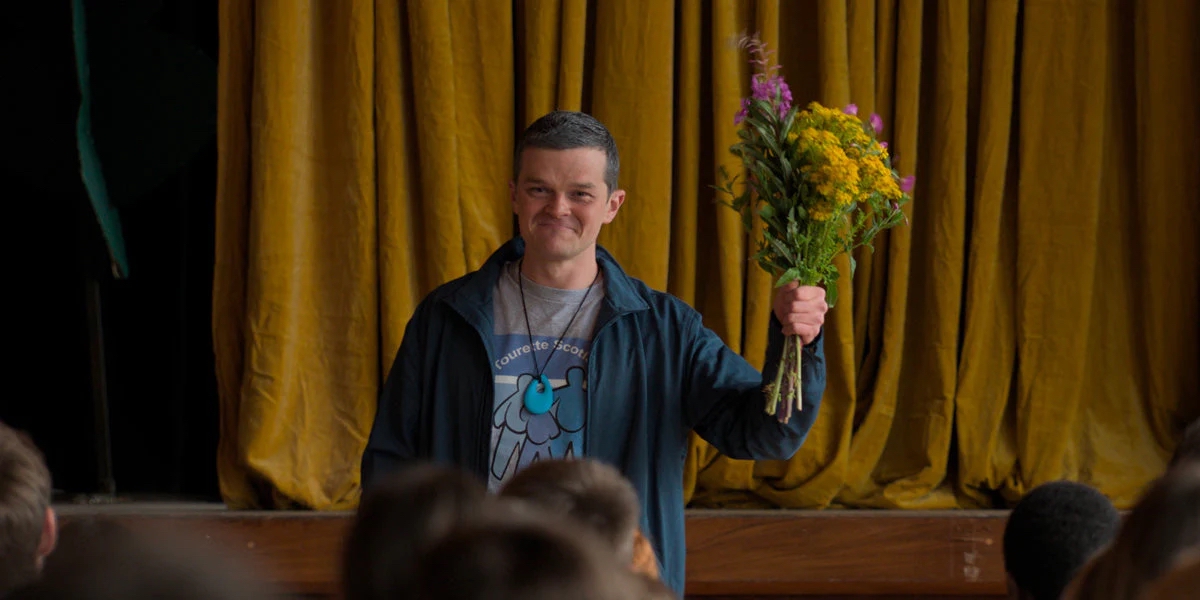
By now, you’ve probably heard about what happened at this year’s BAFTA Awards ceremony. But if not, here’s a quick summary: John Davidson, who has Tourette’s Syndrome, had an involuntary, raw, verbal outburst and yelled the n-word while Sinners stars Michael B. Jordan and Delroy Lindo were on stage presenting an award. The clip quickly went viral.
Davidson was in the audience that night because I Swear, a movie about his life, was nominated for six awards. The film would end up winning half of those, but all anyone seemed to want to talk about was that outburst — and the fact that the film’s star, Robert Aramayo, had beaten out Jordan and Marty Supreme’s Timothée Chalamet for Best Actor, considering everyone (in the U.S., anyway) expected one of those two men to take home the Oscar weeks later, mostly because I Swear hadn’t yet made its way stateside, so it wasn’t on anyone’s radar yet.
With Aramayo’s movie finally hitting American movie theaters this week, what happened at the BAFTAs is back in the conversation. But chances are good that, once people over here actually see the film, the controversy and second-guessing that has followed the ceremony will end.
In I Swear, which was written and directed by Kirk Jones (Waking Ned Devine, Nanny McPhee), we first meet John as a teenager in 1980s Galashiels, Scotland. In these early days, he’s played — with remarkable nuance — by Scott Ellis Watson as a kid with a lot of potential: He’s a talented football goalie being scouted by a collegiate coach, and it’s hoped that John’s talent will break him out of his working-class town.
But then the symptoms start, and John feels confused and painfully aware of how different he is. Watson’s scenes — especially those set in school — are quietly devastating.
Tourette’s Syndrome is a neurological disorder that causes involuntary movements or vocalizations called tics. These can include sudden sounds or words (sometimes offensive ones, like the one at the BAFTA ceremony), but crucially, they’re not intentional or reflective of the person’s actual beliefs. It’s a condition that few understand today, so you can imagine how little they knew in the ’80s, when Davidson was growing up.

Cut to a few years later, when Aramayo takes over as adult John, and I Swear really levels up. Neglected by his mother, who has grown resentful after John’s father left the family, John is taken in by Dottie Achenbach (nicely played by Maxine Peake), the mother of one of John’s school friends and a mental-health nurse. She acts as a mentor, advocate, and emotional anchor. The rest of the film follows John as he navigates adulthood, trying to build a career and maintain relationships while confronting both societal misunderstanding and his own self-doubt, all while Dottie continues to support him.
Through it all, Aramayo’s performance is the film’s beating heart: It’s layered, vulnerable, occasionally prickly, and most of all, completely convincing. The kind of performance people build careers on. (Think Geoffrey Rush in Shine.) Aramayo doesn’t just portray Tourette’s — he embodies John’s constant negotiation with the world around him, the tension between impulse and intention, the exhaustion, the humor, the resilience. It’s layered, unpredictable, and completely magnetic. You can’t take your eyes off him.
In short: Aramayo absolutely deserved that BAFTA award.
I Swear moves quickly — sometimes too quickly. The movie covers a lot of ground; narrative threads are introduced, and you expect some of them to come back and be resolved later on, but they don’t. And while Dottie is surely a good person, she’s portrayed here as a bit too much of a saint, when it’s probably true that she needed more than kindness to break through to John.
Ultimately, though, there’s something almost absurd about how easy it is to root for I Swear. This is, without exaggeration, a full-on crowd-pleaser. It’s funny, bruising, awkward, and weirdly triumphant in ways that sneak up on you. It’s the kind of film that makes you laugh at the exact moment you’re not sure you’re allowed to laugh — and then dares you to sit with that discomfort.
And Jones does all that without pandering to the audience. He and Aramayo present Tourette’s honestly and sympathetically, and they win you over easily.

Which brings me to the real head-scratcher: Why on earth is this movie dropping in the U.S. in late April? I Swear is an awards-season film, full stop. It’s got a breakthrough lead performance, a socially relevant subject, and just enough edge to avoid feeling like homework. Instead, it’s being dropped into a cinematic dead zone, with barely any hype or buzz, so it will surely be overshadowed by films like Michael and The Devil Wears Prada 2.
Don’t let that happen. I Swear is bold without being preachy, emotional without being manipulative, and — most importantly — deeply human. You walk in expecting a “worthy” drama. You walk out realizing you’ve just seen something far more important: a film that actually makes you feel.
If you were shocked by what happened at the BAFTAs, by what Davidson said and that Aramayo won, you should see this movie. You will understand that both incidents should not be controversial. And you will agree that Aramayo should be recognized when next year’s Oscar nominations are announced.
I’m giving I Swear a B+.


What say you? Leave a comment here.