If you’re familiar with the work of Wes Anderson — and if you’ve spent any time on TikTok recently, you should be — then you will not be surprised by the quirky way in which his latest film, Asteroid City, begins.
We’re told that the city itself does not exist. It is, instead, the setting of a play called “Asteroid City.” The events we’re about to see in the film are, essentially, a play-within-a-play — one that was never actually staged.
“The characters are fictional, the text hypothetical, the events an apocryphal fabrication,” explains our host (Bryan Cranston). “But together, they present an authentic account of the inner-workings of a modern theatrical production.”
Alrighty, then.
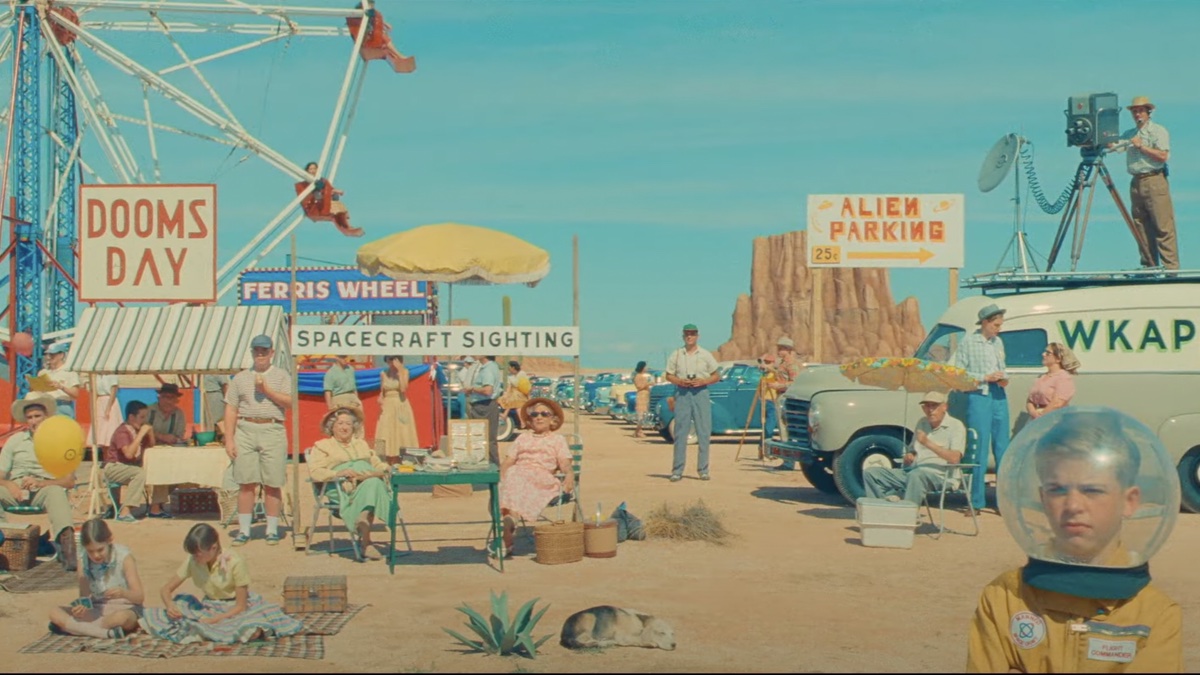
So, Asteroid City is a made-up, tiny desert town in the American Southwest, one you might just miss if you drive by it too quickly. There’s a diner, a gas station/service station, and a motel, and that’s about it. The town’s most famous attraction, its raison d’être, is a gigantic meteor crater and celestial observatory nearby.
What the town is lacking in size, it more than makes up for in population. To that end, the cast of Asteroid City (the movie) is packed, both with Anderson regulars — Edward Norton, Jason Schwartzman, Adrien Brody, Tilda Swinton, Jeff Goldblum, Jeffrey Wright, and Tony Revolori — and company newcomers like Scarlett Johansson, Tom Hanks, Matt Dillon, Steve Carell, Maya Hawke, Liev Schreiber, Hong Chau, Hope Davis, Margot Robbie, and the aforementioned Cranston.
Together, they tell the story of five Junior Stargazers, and how the celebration of their award-winning inventions becomes a crisis situation when an alien appears. To keep things under wraps, the military puts the city on lockdown. Relationships are formed. The kids scheme. Secrets are revealed.
In the midst of it all is a father (Schwartzman) still processing the death of his wife; his father (Hanks), who is there to help take care of his grandchildren; and a famous actress (Johansson), preparing for another role while her daughter attends the stargazer convention.
Anderson’s film jumps back and forth between the events of the play and the actors’ behind-the-scenes preparation for the upcoming production, all in an apparent attempt to illustrate how life is processed through art, and vice versa. I think.
Regardless, it’s a lot. Too much. There’s so much going on visually, there are so many characters, and the screenplay is so stuffed with meta commentary and weirdness that eventually, it gets a bit frustrating. Actually, the longer the film goes on, the more it becomes a little unclear just what, exactly, is happening and if there will ever be any resolution.

The real joy of this movie — and, to be clear, there’s a lot of that, too — is found (not surprisingly) in the details of the production design. Asteroid City itself is legitimately gorgeous, with its widescreen, peach-colored hues, and its features heightened to an almost comical degree. This is contrasted with the more realistic but equally dense, monochrome, 4:3 frame of the theater, as we see the playwright (Norton) work out his creative process.
In both settings, there’s plenty to see, and much of it is only on screen for a brief second, which makes Asteroid City the kind of film that demands a rewatch just so you can catch everything. (A big screen helps, but so would a “pause” button.)
Anderson’s trademark dry wit is also on full display. At one point, Cranston’s host enters a scene, breaking the fourth wall. Everyone else stops and shoots him an accusatory glance. “Am I not in this?” he asks, then shuffles out of frame. It’s a quick and random aside, a visual joke among many amusing sight gags in the film.
At this stage in his career, Anderson’s films and his trademark style have become so recognizable and expected that they’ve become a bit of a cliché. Thus, the TikTok trend. You can count me among those who are still here for it, even if Anderson’s most recent work isn’t as engaging as his earlier work — such as Rushmore (my all-time favorite film, period), Moonrise Kingdom, or The Grand Budapest Hotel (my favorite film of 2014 and my number–three film of the 2010s). I kind of miss early-career Anderson, when his films were simpler and more emotionally resonant, before they got so overstuffed and over-stylized.
These days, it seems to be style over substance. In that spirit, Asteroid City isn’t one of Anderson’s strongest works, but it’s still a pleasure to watch. Or at least, to look at.
I’m giving it a B.
 Martin's Musings
One Response to ““Asteroid City” Is a Lot. What It’s a Lot of Isn’t Always Clear”