With its lush cinematography, precise period details, and performances so controlled they practically scream “For your consideration,” Hamnet is one of those movies that feels engineered from the ground up to earn award consideration — if not a few little gold men themselves.
And to be fair, it is a beautiful movie. Director Chloé Zhao clearly put a lot of thought and care into the look and feel of her latest work. Every frame feels deliberately composed and drenched in a kind of quiet melancholy that fits the subject matter perfectly. (Though, some shots do appear to be lifted straight out of a Terrence Malick film.) The acting is top-notch across the board, too, with grounded, intimate performances that pull you in even when the movie itself drags.
But that’s the thing: For about three-quarters of its length, Hamnet is … a bit dull. Not offensively so, not “check your watch every 10 minutes” dull, and certainly not “to sleep, perchance to dream” dull. Just slow, restrained, and very interior. As expected.
The film tells the story of Agnes and William Shakespeare (Jessie Buckley and Paul Mescal): how they meet, fall in love, and start a family, only to be devastated when their young son Hamnet (Jacobi Jupe) dies suddenly. Agnes is overcome with grief and feels abandoned when her husband — spoiler alert? — goes off to London, where he had already been spending much of his time, and, unbeknownst to her, writes a play about their son.
Zhao, who adapted the book Hamnet with its author, Maggie O’Farrell, leans hard into mood and atmosphere, sometimes at the expense of momentum. The film wants you to sit with grief, longing, and the blurred lines between art and life — but it also occasionally forgets to keep you emotionally hooked along the way. You can feel the movie holding back, waiting for its big thematic payoff. Depending on your patience level, that may or may not work. (It didn’t for me.)

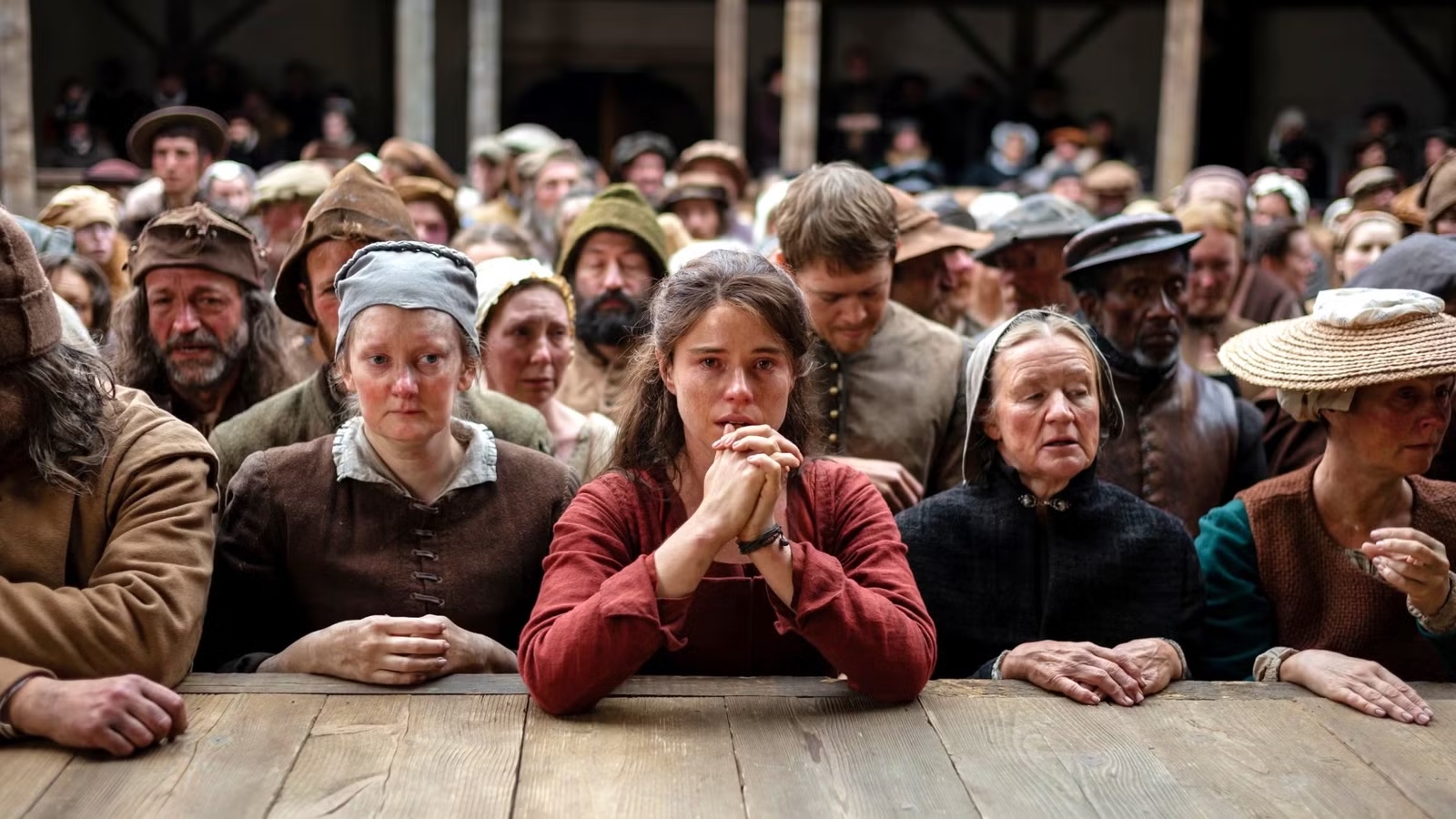
Then comes the final scene at the Globe Theatre (impressively recreated), and suddenly everything seems to come together. Here, we watch Will’s play, The Tragedy of Hamlet, with Noah Jupe (yes, Jacobi’s older brother) as the actor playing the title role, and Agnes watching from the front of the stage. (An on-screen note at the start of the film lets us know that the names Hamnet and Hamlet are interchangeable.)
The sequence is moving, clever, and undoubtedly cathartic — not just for the Shakespeares but for us as viewers who’ve been wading through the quieter, earlier parts of the film, wondering when or if things might pick up.
At first, Agnes is frustrated that her husband has used their personal tragedy as fodder for his very public fiction. But she soon comes to realize that Will has channeled his grief into the play. Thanks partly to that smart casting choice, this scene effectively illustrates the film’s central theme: how personal loss can be expressed through an artistic work.
Is Hamnet as good as Nomadland, Zhao’s 2020 Oscar-winning film? No. That one had an authenticity and emotional clarity that Hamnet doesn’t match. But thankfully, it’s also far from Zhao’s dreadful contribution to the MCU, Eternals. Think of Hamnet as Zhao returning to her strengths — intimate human drama — just with a more classical, deliberately paced approach.
In the end, despite the slow patches, Hamnet’s powerful final act and strong performances are what will make the film an awards contender this year. (Having Steven Spielberg and Sam Mendes as executive producers should help, too.) Call it a flawed but resonant piece of Oscar-bait that almost earns the hype. Almost. As Hamlet himself says in the play: “The readiness is all.”
I’m giving Hamnet a B.
 Martin's Musings
2 Responses to “Not to Be”