
“Every story matters.” That’s something Guy, our excellent tour guide, said on the first day of my trip to Israel in June 2024. It’s a quote that’s stayed with me all these months since I first heard it.
I was visiting Israel as part of a Jewish National Fund (JNF) volunteer mission, and indeed, over the course of my time there, I heard many stories about what happened on or because of October 7 — stories of horror, cruelty, and sadness, but also stories of heroism, resilience, and hope. Every single one of them was significant.
This week marks two years, 24 months, 104 weeks, 732 days, since October 7. As the war in Gaza has dragged on and propaganda has altered the narrative for people around the world, the events that started it all, the reason Israel went into Gaza in the first place, have unfortunately receded into the distant memory of too many. Some deny what happened, and others would like to brush aside the attack entirely, but we cannot allow that day to be forgotten. We must remember it. Bearing witness and sharing stories are the best ways to make sure nobody ever forgets what happened.
Thankfully, to commemorate the anniversary, there are lots of stories being shared. For example, HBO Max and Paramount Plus each have series that dramatize the events of October 7, Amazon Prime Video has a new documentary, Eli Sharabi’s book Hostage shares the ordeal of his 491 days in Hamas captivity, and the award-winning film The Road Between Us is now in theaters. (Yes, there’s also cautious optimism that we may be close to a deal to end the war and finally bring home the remaining 48 hostages, living and deceased. But that’s another story altogether.)
I did my best to write down or somehow capture as many of the stories I heard or experienced on my trip. Of course, it was difficult to remember everything and every detail. There were so many.
Nevertheless, here, in abbreviated versions, are some of the notable ones. To protect people’s identities, I’ve removed most of the last names.
Three miracles
Elan is a farmer from Ein HaBesor, a moshav (a type of cooperative agricultural community of individual farms) located about four miles from the Gaza Strip. He, along with dozens of other members of his community, bravely fought off Hamas terrorists on October 7, with only four M16 assault rifles and some pistols.
Elan specifically mentioned three miracles to us. The first was that he didn’t allow his daughter to stay the night at Kibbutz Be’eri on October 6, as she usually did on Shabbat. The second was that, the night before, he had a feeling that he should check the rear gate of the moshav; doing that is probably what saved the whole community from being attacked. And the third was that the first responders had been fighting off the terrorists when Elan and the others started to run out of ammunition. It was then that the terrorists suddenly left the area. Elan said he believes it was because the Ein HaBesor first responders had killed the Hamas commander.
Operating on numbers, not names

Soroka Medical Center, the only major hospital in southern Israel, is where 680 wounded patients were treated on October 7 alone. Located just 22 miles from Gaza, Soroka has led the medical response to the war. (In June, it was hit by an Iranian missile.)
A senior surgeon at Soroka described the chaotic scene in the hospital on October 7. Many of the patients that day came from the Nova Music Festival, and the team of doctors had to operate on “numbers, not names” because so few people had IDs with them. (Apparently, Israel is less strict about checking them, so many at “the party” didn’t even bring them.) In one case, doctors thought a man was a woman because his genitalia had been removed by the terrorists — which indicated to us exactly what kind of condition he was in.
Reliving our fight
Yedidya was born and raised in Gush Katif in the Gaza Strip, where his parents settled after they were evacuated from the Sinai Peninsula in the early 1980s. When Israel disengaged from Gaza in 2005, Yedidya’s family was forced to leave their home. He shared this story with us and described how this has given him a unique perspective on the events of October 7 and the months since.
Yedidya is a reservist in the IDF. On October 7, he fought off terrorists at his kibbutz and then was called back into duty to fight in the ongoing war. “It’s like we are reliving our fight for independence,” he said. Someone in our group asked when he thinks the war will end. Yedidya’s response: “When they’re too afraid of us to do anything.”
The Battle of Sderot
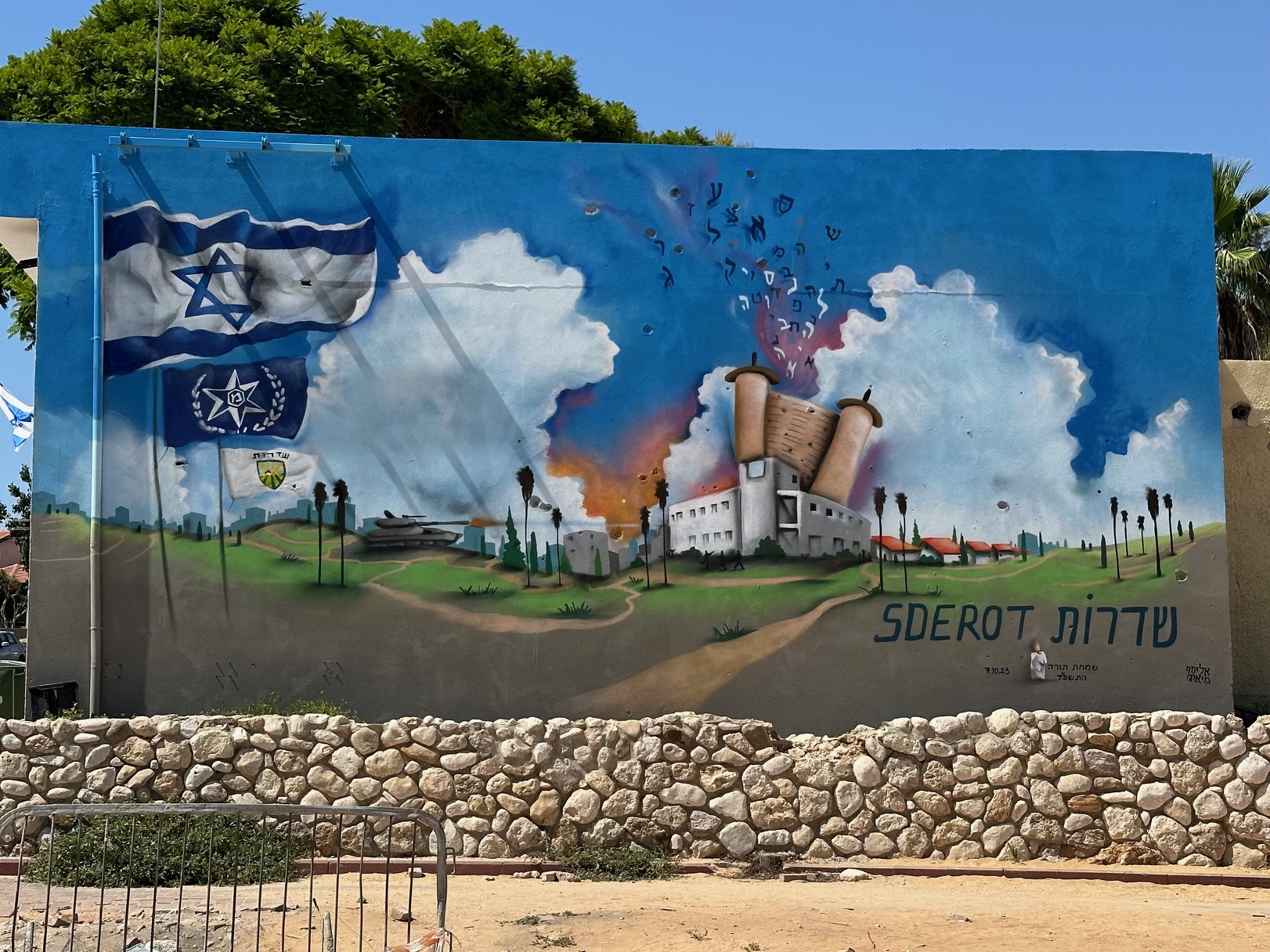
Sderot, the closest Israeli city to the Gaza border, was the largest city that Hamas attacked on October 7. At least 70 people were killed there. In the days after, about 90% of the town’s 28,000 residents were evacuated (though many have since returned). We saw bullet holes in buildings and a playground that used to be active that was completely empty, since parents were too scared to let their children play there.
The Sderot police station, where 10 officers were killed in a standoff that left the station in ruins, was an empty lot. On the day of our visit, twisted metal remained, and Israeli flags fluttered in the wind. (Months later, a memorial was built in its place.)
There are now multiple large murals in the city that commemorate what happened on October 7 — including one that shows a Torah scroll coming out of the police station and letters coming out of the flame. The letters signify life, so the message of the mural is, essentially, “We live on.”
While we were in Sderot, Ayala, the mother of Mor Shakuri, one of the cops who died defending her city, drove by. Ayala got out of her car and started telling us about her daughter, a hero, who “went down fighting,” Ayala said. Apparently, Ayala was on the phone with Mor when she died; she was found with two guns drawn. Ayala told us she visits the site every day, and that Mor was supposed to be married in July, a couple of weeks after our visit. (Sadly, later that year, Ayala’s husband, Roni, was shot by a terrorist.)
The Nova site
A couple months before my trip, I visited the Nova Music Festival exhibit in New York, and even that didn’t prepare me for the sheer scale of visiting the actual site of the festival at Re’im, and what it was like to see in person all those poles representing the 364 attendees who were killed and the 40 who were taken hostage on October 7.
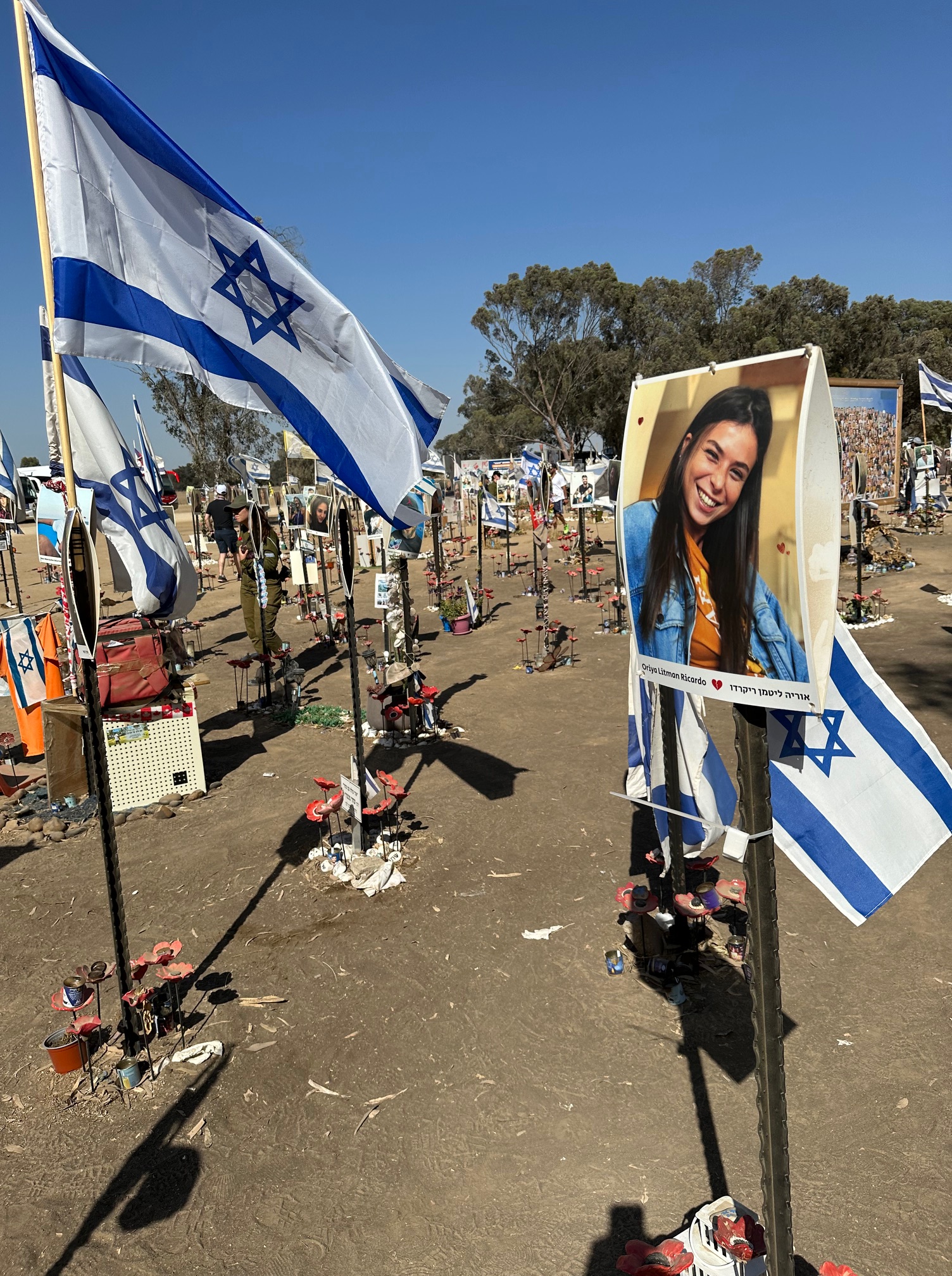
Wandering around the site, looking at the names and photos, I kept my eye out for certain people, including Hersh Goldberg-Polin; Oriya Litman Ricardo, whose mother I met at the exhibit in New York; and Michael and Osher Vaknin, who I learned about at the exhibit, as well. The identical twins’ poles, which faced each other, had signs on them with the messages “We ride together” and “We die together.”
Busloads of visitors arrived often. But the site was still eerily quiet, aside from the sniffles, with everyone there seemingly taking part in a communal mourning ritual. There were even groups of soldiers; apparently, it is common practice for the IDF to bring new soldiers to the Nova site to remind them of why they’re fighting.
At the festival, attendees were shot, raped, bludgeoned, or burned to death. Much of that violence happened when victims were tied to trees. Words weren’t necessary; the still-dangling ropes and deep bullet holes in the wood told the story.
On these same grounds, new trees have been planted in memory of those festival attendees who were murdered on October 7. The initiative, sponsored by the JNF (natch), hopes to bring new life to the scene of death and desecration.
Many festival attendees ran through a field trying to escape from the Hamas terrorists who had attacked the site. Some hid in a roadside bomb shelter just outside Re’im, a place now referred to as the “bunker of death.” Standing inside the small structure, seeing the dents and holes and the walls graffitied with the names of victims and visitors, it was not hard to imagine the gruesome, terrifying scene that morning. Grenades were tossed, bullets were sprayed. Sixteen people were murdered. Four people were taken alive and brought to Gaza: Hersh Goldberg-Polin, Alon Ohel, Eliya Cohen, and Or Levy. And miraculously, seven people managed to survive and were later rescued — including Yuval Raphael, who hid from the terrorists under her murdered friends, and who represented Israel at Eurovision earlier this year.
“The most afraid day of my life”
In Okafim, we spent time with Osi, a caterer. October 7 was not Osi’s first interaction with Hamas; years earlier, a rocket fell right in front of her house. She still has the shell, and she showed it to us. But October 7 was “the most afraid day of my life,” she told us.
In the days after, she was so distraught that she “ran away” to Tel Aviv. But then she thought about it and came to her senses. She remembered that she doesn’t run away. She helps. She cooks. So, she started cooking for soldiers, and now often hosts groups like ours in her home to help her do that. That renewed purpose has given Osi the strength to continue.
Osi explained that her mother had passed a week before October 7, so thankfully, she didn’t have to experience that horrific day herself, and Osi didn’t have to worry about protecting her. Osi also said her son was in the IDF but was traveling instead of fighting, a fact that she didn’t mind: “It’s better for me to miss you than to worry about you,” Osi recalled saying to him.
“I trembled”
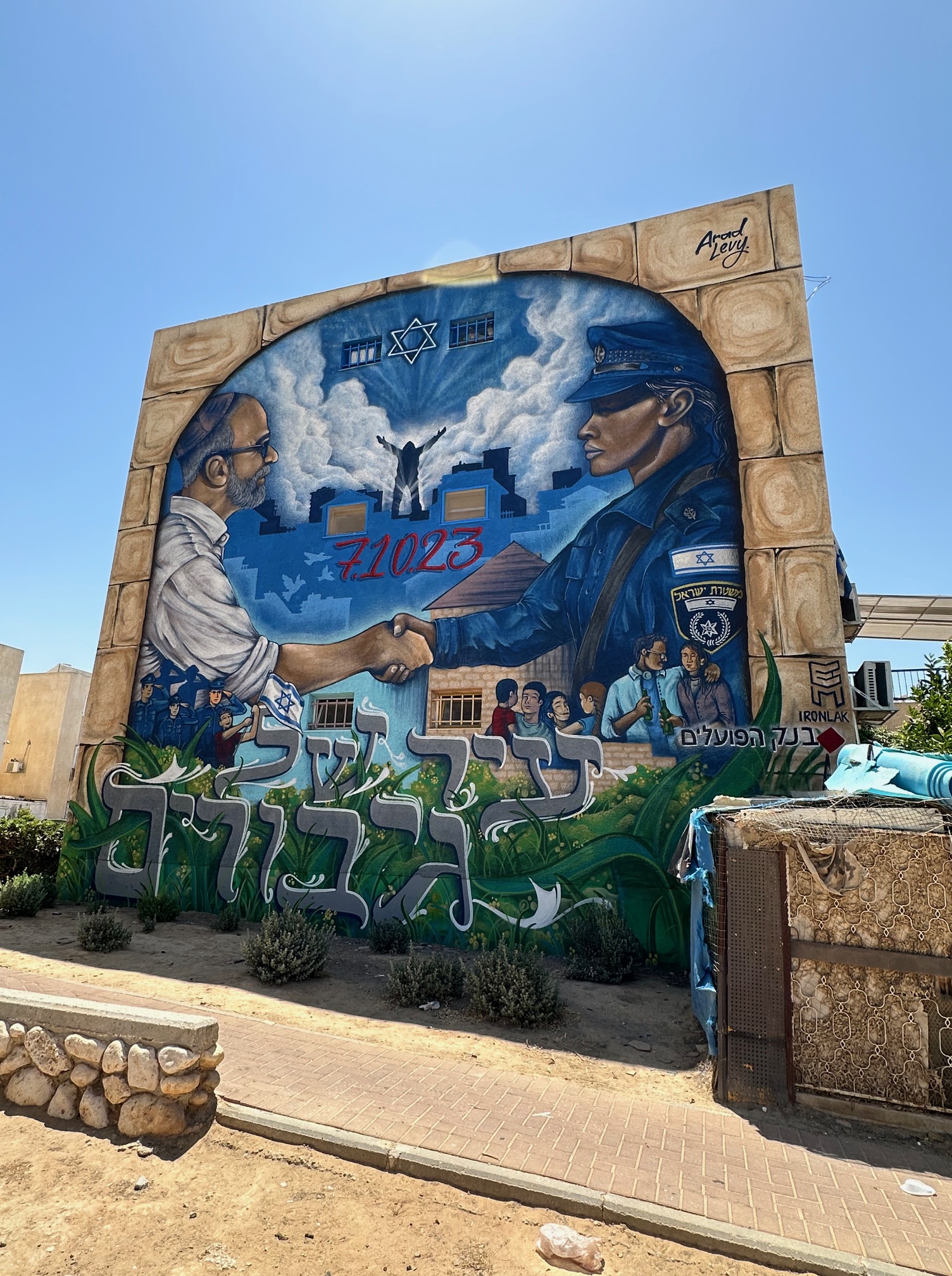
Itamar, a police officer who also lives in Okafim, considers it a miracle he’s still alive, because on the morning of October 7, while defending his city from Hamas terrorists, he could have died at least six times, he told us. Itamar lost friends in the battle, but his actions saved the lives of many other people. “They called me a hero, but I don’t feel that way,” he said. “I was afraid for my life. I trembled.”
We drove around the town, and Itamar pointed out sites where different incidents took place on October 7. And then we stopped to look at a beautiful mural commemorating the events of the day and the way police and civilians worked together to save the city.
Divine intervention
One of the more memorable parts of the trip was visiting ADI Negev-Nahalat Eran, an impressive rehabilitative village that cares for children and adults with severe disabilities.
Elie, the director of development for the U.S. and Canada, told us the story of what happened there on October 7, and how it took an hour to get everyone to a safe space. Given the facility’s location just off Route 232 — a main thoroughfare of the Gaza Envelope area that Hamas used, and that Israelis now call “the bloody road” — he said he considers it divine intervention that Hamas didn’t attack them that day. Amen.
Not that the facility escaped without tragedy: One therapist, Edna Malkamo, went home at 7 a.m. to join her family in their safe room, after completing a night shift, and was killed by Hamas terrorists before she got there. Apparently, her patients, who didn’t quite understand what had happened, waited for her to return for 30 days.
“A hell of a writer”
Everyone on the mission was given the name of an IDF soldier who had fallen in the war, and we were encouraged to look them up and learn about them. Then, on day four of the trip, we visited Neot Kedumim, a biblical nature reserve and JNF planting center, and we planted trees in memory of each of these fallen soldiers.
I was given Captain Omer Wolf, a 22-year-old Golani soldier from Kibbutz Givat Haim, who was killed on October 7 battling Hamas terrorists near Kibbutz Nir Oz. That morning, he and three other soldiers piled into an armored vehicle to do a routine patrol along the Gaza border fence. They were the first to encounter the invasion of Hamas terrorists into southern Israel, engaging in battle with a group of them that lasted for more than an hour at five different locations. As a result of this fighting, Omer and his fellow soldiers prevented eight terrorists from entering Kibbutz Nirim and succeeded in delaying the invasion by two hours.
After his death, Omer’s parents discovered that he had been writing songs that he had not shared with them. Israeli singer and composer Rami Kleinstein took it upon himself to finish one of Omer’s songs. “This Omer Wolf was a hell of a writer,” Kleinstein said when he performed the song live a few weeks later.
Supporting the hostage families
So-called Hostages Square, outside the Tel Aviv Museum of Art, is a central place for much of the activity related to those still held captive in Gaza. There are art exhibits — some of which have been there since just after October 7, some of which have changed over time, and some of which are more recent additions — and tents representing the affected kibbutzim where family members go to tell stories about their loved ones. There is also merchandise on sale to benefit the Hostages and Missing Families Forum.

Outside the tents for the various kibbutzim, there is a message written in Hebrew in small rocks: “We are waiting for you.” Many of the stones have the names of victims or hostages on them, or messages of love and support, and a good number of them say “Am Yisrael Chai.”
Notable exhibits in the Square include a piano to honor Alon Ohel, a 23-year-old pianist who was taken captive from the aforementioned “bunker of death” near the Nova Music Festival, and who is one of the remaining 48 still in Gaza. Visitors are encouraged to play the piano and keep Alon in their thoughts.
When some of the hostages were freed in November 2023 as part of a deal, they described being fed one pita a day. In Hostages Square, there’s an installation and a poem with that theme.
There’s also a tunnel built to give visitors a taste of the conditions hostages face in the Hamas tunnels, such as cramped spaces and lack of daylight (though obviously, this tunnel is short and above ground, so there is daylight at both ends). Inside, you can hear the sound of gunshots in the distance played through speakers.
But there are also messages of hope in the tunnel for those still being held captive in Gaza, lots of stickers (including one with the message “Hug whoever is next to you”), and written pleas (and curses). And at the end, as you walk out, there is the Biblical message “Let there be light.”
Dizengoff Square is another place to mourn the victims of October 7 and call for the return of the hostages. It began as a community gathering place to light yahrzeit candles, but became a site filled with candles, photos, stuffed animals, written pleas, dedications, collages, and prayers, all conveying the agonizing pain that has overwhelmed Israel since October 7.
At the airport
From the moment you land in Israel, you’re reminded of the hostages still being held by Hamas in Gaza. Kidnapped/Bring Them Home Now posters line the walkway as you go to baggage claim and customs. Names you’ve heard and faces you’ve seen so many times. Many of the posters have additional notes of love and support written on them. As excited as you are to arrive in Israel, the message is clear: No one is home until everyone is home.
The posters are also there as you walk to the departure gates. Thoughts of the hostages are ever-present in Israel, so here, it’s almost like they’re saying, “Don’t forget about us when you leave.”
Of course, there are fewer posters lining the walkways now than when I was in Israel 16 months ago. Every time a hostage has been released or rescued, or their body was recovered and brought home, airport staff members remove their poster. Hopefully, soon, there will be no posters left because all the hostages will be home.
Learning how to live
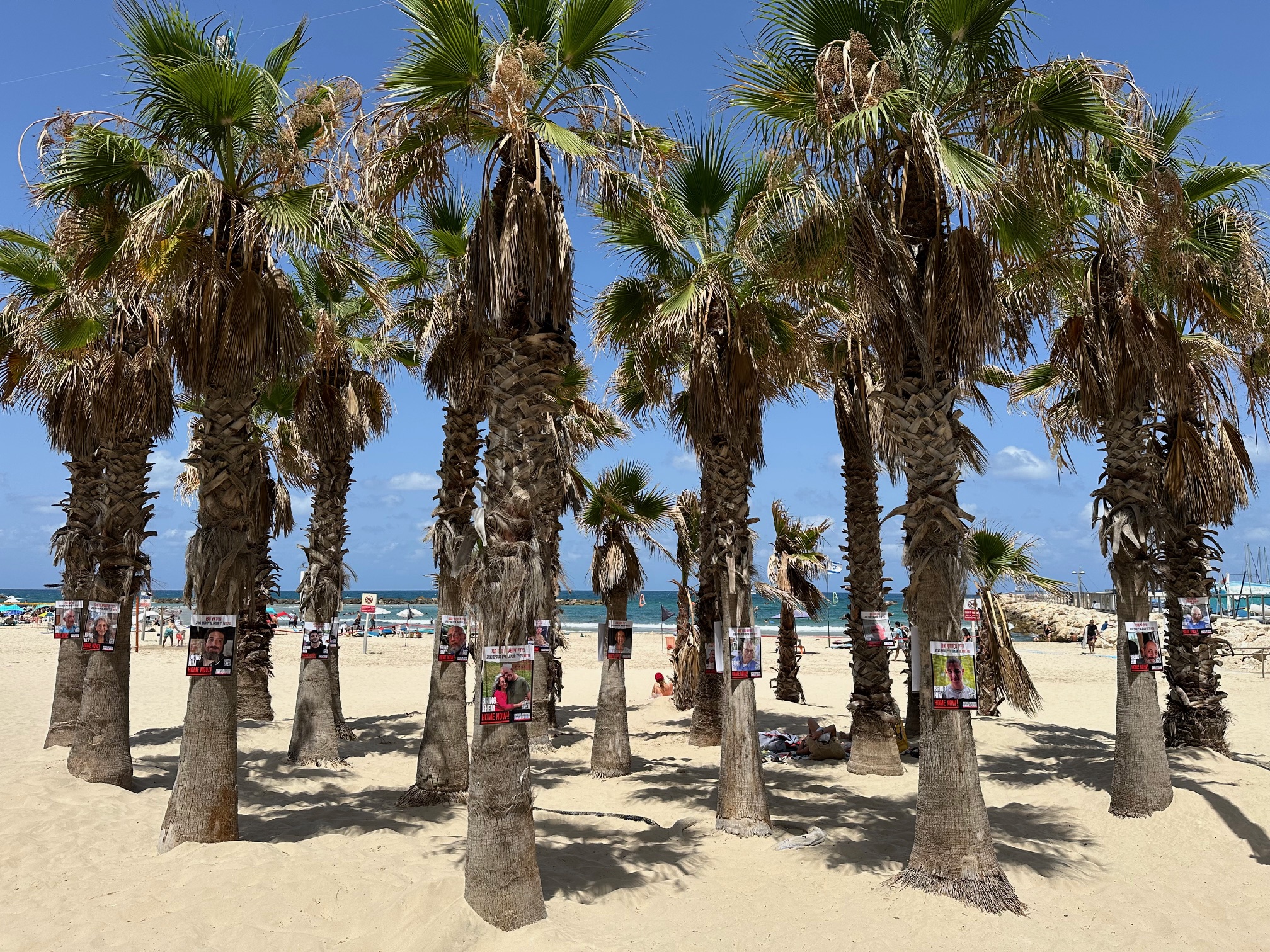
There was (and continues to be) a lot of pain in Israel, especially in the southern part of the country near the Gaza Envelope. But on my trip, things changed when I arrived in Tel Aviv. There, my friend Josh said another line that stayed with me: “In Israel, you learn how to live.” In Tel Aviv, I saw this first-hand. Life goes on in Tel Aviv … nonstop, as the city’s marketing slogan says. Tel Aviv is on the move almost 24 hours a day, seven days a week (yes, even on Shabbat). Accordingly, I was endlessly fascinated by the juxtaposition of seeing the Bring Them Home Now posters and yellow ribbons on palm trees, outside crowded bars and clubs, as people walked, ran, biked, and rollerbladed by.
The message was clear: The best “revenge” against those who want us dead is simply to live. Not to forget the pain and heartbreak of what’s happening just miles/kilometers away, but to live. And so, in Tel Aviv, there was a lot of life.
Two years after October 7, the memories of that day remain, and the stories continue to be told. I know I won’t ever forget hearing these or experiencing them for myself. They remind me of the importance of living proudly as a Jew, in spite of so many who root against us. Here’s the important thing: We’re not going anywhere.
Am Yisrael Chai, indeed.
 Martin's Musings
4 Responses to “Every Story Matters: Remembering the Horror and Heroism of October 7”