For many fans, music is personal. We become attached to certain songs because they help us remember specific events, we identify with the lyrics our favorite artists write or sing, we experience concerts as communal gatherings, and we associate certain artists or songs with the best or worst of times.
Accordingly, when movies are made about our favorite performers, we want to see them done well, and for those artists to be represented credibly and respectfully. The more iconic the performer, the greater the risk.
Not surprisingly, the results are usually a mixed bag, especially in recent years. For every Bohemian Rhapsody, in which Rami Malek channeled Freddie Mercury and won an Oscar for it, there’s an I Wanna Dance with Somebody, in which Naomi Ackie barely made an impression as Whitney Houston.
Better were films like Elvis and Rocketman, in which Austin Butler and Taron Egerton impressively captured the vibes of Elvis Presley and Elton John, respectfully, even if they didn’t exactly look like those legendary artists. They both did some of their own singing, too, in addition to lip-synching to the original tracks. (For the record, Elvis was one of my favorite movies of 2022, and Rocketman was an honorary mention in 2019.)
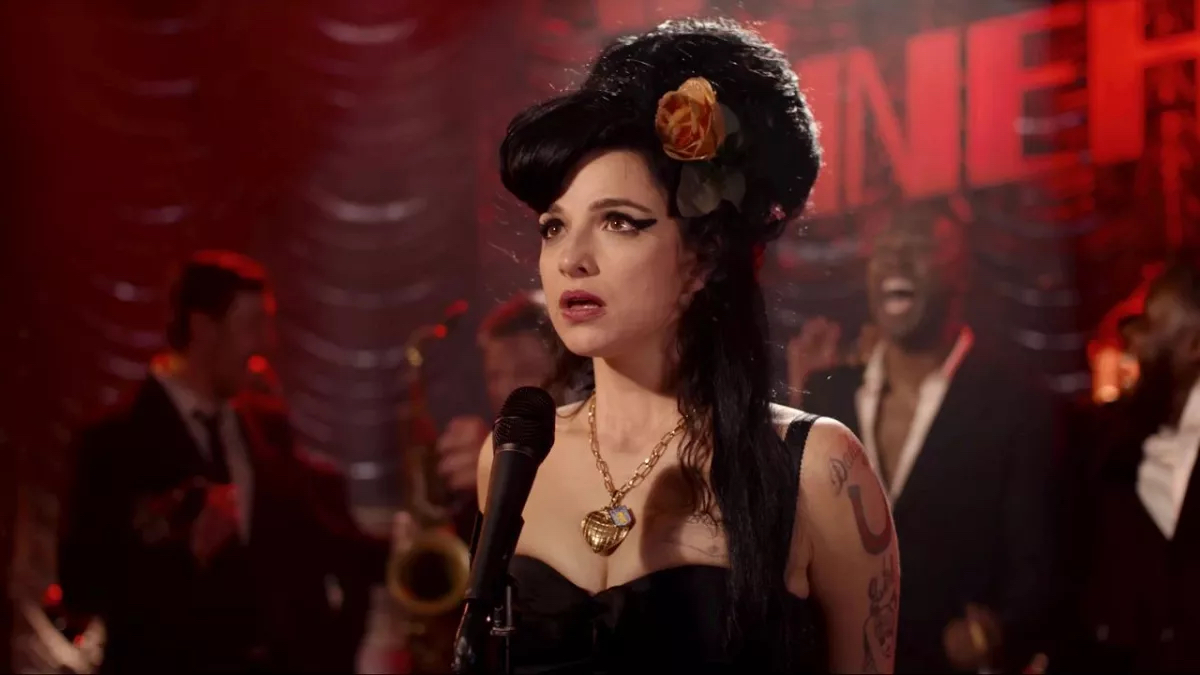
Now we have Back to Black, in which Marisa Abela (one of the stars of the HBO show Industry) plays one of my all-time favorite artists, Amy Winehouse.

Known for her brash charisma, her unique sound (which mashed up Sarah Vaughan, the Shangri-Las, and Lauryn Hill), and her distinctive look — that old-school beehive hairdo — Winehouse was one of the most recognizable artists of the early 21st century. She gained worldwide fame with songs like “Rehab” and “Valerie” (a cover of a Zutons track), and critical acclaim for her two full-length albums. In 2008, she took home five Grammy awards for the second of those albums, Back to Black, which ranked number 33 on Rolling Stone‘s most recent list of the “500 Greatest Albums of All Time.” And then, at the peak of her career, Winehouse’s life spiraled out of control, the result of a toxic relationship and drug and alcohol addiction, not to mention endless harassment by the paparazzi. In 2011, when she was just 27 years old, Winehouse died, leaving many of us sad and wondering what could have been.
If you’re thinking, wasn’t there just a movie about Winehouse a few years ago, you’re right: Asif Kapadia’s Amy was one of my favorite movies of 2015 and the Oscar-winner for Best Documentary Feature in 2016.
Kapadia’s film is a heartbreaking look at the too-short life and career of the British singer, and it illustrates in devastating fashion how the destructive powers of fame, love, and drugs can completely overwhelm a person. Amy makes brilliant use of home movies and interviews, and it gives context to some of Winehouse’s most well-known songs. The end result is you hear her music as if for the first time and you’re able to appreciate her gifts even more than you probably already did.
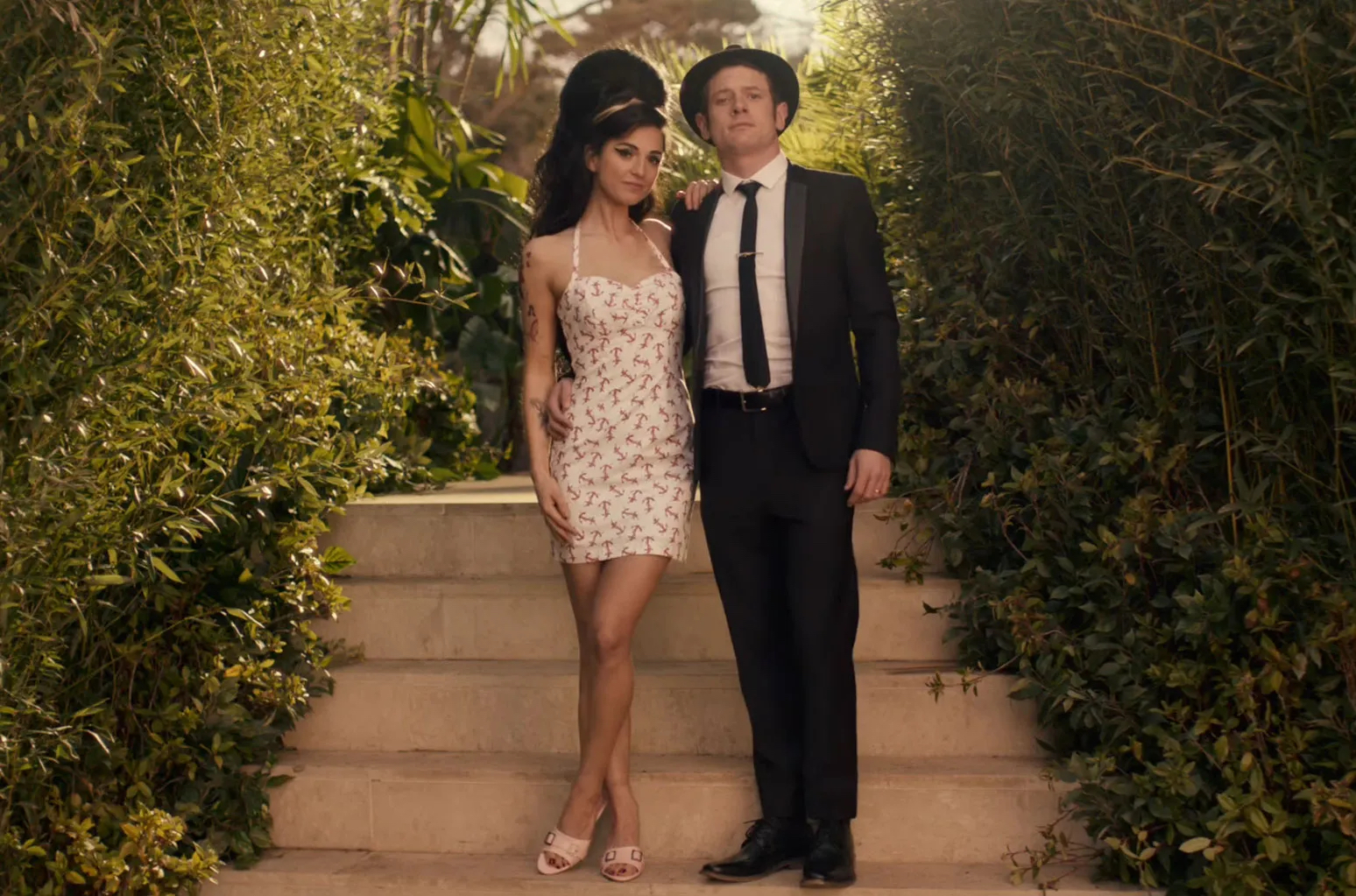
But yes, now there’s another movie about Winehouse, Sam Taylor-Johnson’s Back to Black, which gets its name from that Grammy-winning album. The film dramatizes Amy’s rise from a teenage songwriter to a global superstar, and of course, it also covers her relationship with Blake Fielder-Civil (Jack O’Connell), who is generally blamed for Winehouse’s addictions and, ultimately, her death.
To cut to the chase, this new film is not as good as Amy or entirely worthy of the huge talent Winehouse was. In fact, some aspects of it are a bit problematic. But I’ll admit that, despite the way it sanitizes Winehouse’s story, and despite some frustrating choices by the filmmakers, I found Back to Black to be likable enough, faults and all.
One reason for that is Abela’s performance. Like Butler and Egerton before her, Abela doesn’t exactly look or sound like the artist she’s playing — though the hair and makeup team do a valiant job replicating her memorable looks from back in the day. That said, Abela has the intonation of Winehouse’s voice right, and she does a respectable job, portraying Amy sympathetically.
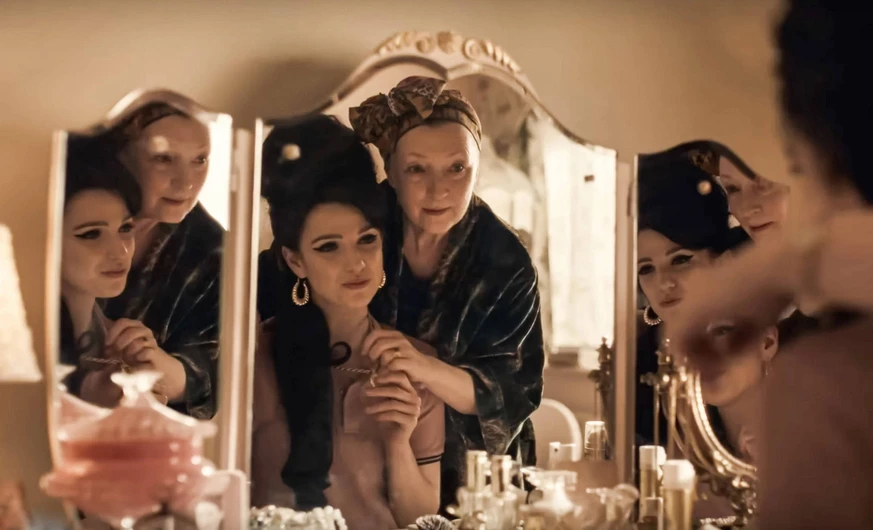
The film distinguishes itself from Kapadia’s film by focusing more on Amy the person than Amy the tabloid fodder. To that end, Back to Black spends a lot of time showing how Winehouse’s tight relationship with her grandmother, Cynthia (Lesley Manville), inspired the type of artist she would become. The scenes of them together are sweet and endearing. And we see how close Amy was with her father, Mitch (Eddie Marsan), who is portrayed here as a loving and supportive figure in Amy’s life.
The problem is, it’s been well documented that Mitch did not always have his daughter’s best interests at heart. He could be greedy and opportunistic, such as when he brought a camera crew to a St. Lucia retreat where Amy was supposed to be getting clean. And, of course, he famously said his daughter didn’t need to go to rehab, despite her obvious problem (“If my Daddy thinks I’m fine,” as the song goes). So it’s hard to buy into some of what we see of their relationship here.
And, while the film does show Amy’s struggles with alcoholism, it largely overlooks her drug addiction and her bulimia, which feel like rather large omissions. That’s at least partly why Fielder-Civil seems to get a pass — he introduced the drug-averse Winehouse to heroin and cocaine, but is presented here as the sensible one who later recognizes the toxic codependency of their relationship. (O’Connell is charming, though, and the scenes dramatizing Amy and Blake’s early courtship are some of the film’s best.)
Most criminal, perhaps, is that for all the fuss the movie makes about how good an artist Winehouse was, Back to Black doesn’t show much about Amy’s creative process or how the music came together. There’s very little of her writing her songs or working in the studio with producer Mark Ronson, who collaborated with Winehouse on Back to Black — he’s name-checked but barely shown — and the name “Dap-Kings” isn’t even mentioned once. (If you don’t know, the Dap-Kings were her backing band, a role they later served for Sharon Jones.) The film does allude to some of the music’s inspiration, but for the most part, the songs just kind of exist.
And yet, the music is still great. It’s a treat to hear songs like “Tears Dry on Their Own,” “Me & Mr. Jones,” “Stronger Than Me,” and “Love Is a Losing Game” in a theater with good sound. And the recreations of Amy’s gigs at Ronnie Scott’s, Shepherd’s Bush Empire, and Glastonbury, among others, are well done. Though, why Taylor-Johnson decided to have Abela sing instead of having her lip-synch to Winehouse’s tracks is … a choice. Abela is fine, close enough, but she’s noticeably not Amy Winehouse. (Thankfully, it’s Winehouse on the film’s actual soundtrack, not Abela.)
Also, kudos to the filmmakers for making multiple acknowledgements of the fact that Winehouse was Jewish. A Star of David necklace around her neck is ever-present — which is sure to annoy those who defaced her statue in February (shame on those people) — and an early scene features Amy’s family singing the song “Tzur Mishelo.” Much appreciated.
Back to Black may not tell a complete version of Amy Winehouse’s story. It may not do justice to the Amy fans like me still miss to this day. But it’s enjoyable enough and, against all odds, I didn’t hate it. I guess Abela’s performance is just that good.
That said, if you want the real story about Winehouse — or a realer one, anyway — you’ll have to watch the documentary.
I’m going to continue the alliteration by giving Back to Black a B–.
 Martin's Musings
One Response to “A Less Than Iconic Movie about an Iconic Artist”